I recently gave a lecture at the Western Veterinary Conference called “What You Know that Ain’t Necessarily So.” The purpose of this was to take some common or controversial beliefs and practices in veterinary medicine and discuss the scientific evidence pertaining to these. This was not intended as a definitive, “final word” on these subjects, but as an illustration of how weak and problematic the evidence often is even behind widely held beliefs. In some cases, these practices or ideas may actually be valid, but without good quality scientific evidence, we should always be cautious and skeptical about them.
Eventually, I will post recordings of the presentations themselves, but for now I am posting a summary of each topic.
Each starts with a focused clinical question using the PICO format.
P– Patient, Problem Define clearly the patient in terms of signalment, health status, and other factors relevant to the treatment, diagnostic test, or other intervention you are considering. Also clearly and narrowly define the problem and any relevant comorbidities. This is a routine part of good clinical practice and so does not represent “extra work” when employed as part of the EBVM process.
I– Intervention Be specific about what you are considering doing, what test, drug, procedure, or other intervention you need information about.
C– Comparator What might you do instead of the intervention you are considering? Nothing is done in isolation, and the value of most of our interventions can only be measured relative to the alternatives. Always remember that educating the client, rather than selling a product or procedure, should often be considered as an alternative to any intervention you are contemplating.
O– Outcome What is the goal of doing something? What, in particular, does the client wish to accomplish. Being clear and explicit, with yourself and the client, about what you are trying to achieve (cure, extended life, improved performance, decreased discomfort, etc.) is essentially in evidence-based practice.
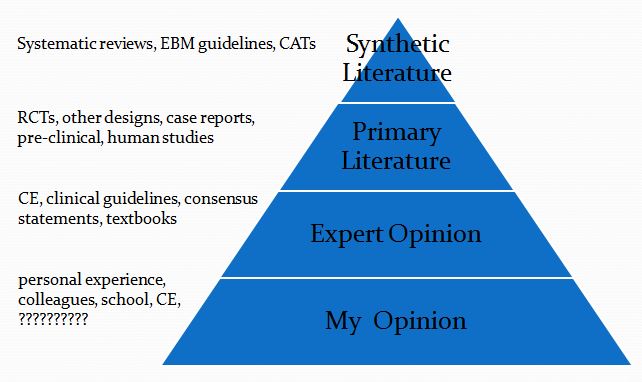
This is then followed by a summary of the evidence available at each of the levels in the following pyramid (which is a pragmatic reinterpretation of the classical pyramid of evidence that is a bit more useful for general practice veterinarians).
Finally, I list the Bottom Line, which is my interpretation of the evidence.
Pre-anesthetic Bloodwork in Healthy Animals
- Clinical question
P– healthy dogs & cats
I– routine cbc/chem before anesthesia
C– no bloodwork
O– mortality, complications, change plan
2. Synthetic Veterinary Literature
a. Systematic Reviews- none
b. CATs- none
c. Guidelines- none
3. Primary Veterinary Literature-
- cbc/biochemistry profiles for 1537 dogs
- university surgery population
- variety of ASA stages
- No indication in PE/Hx for labwork in 84%
- Recategorized in ASA level- 8%
- Procedure postponed- 0.8%
- Additional therapy- 1.5%
- Change in protocol- 0.2%
- Complications in 1.9% of patients
- Lab values normal or unrelated in 84% of these
- 3.8% incidence with lab abnormalities
- 1.8% incidence with normal labs (no statistical difference)
The changes revealed by pre-operative screening were usually of little clinical relevance and did not prompt major changes to the anaesthetic technique…In dogs, pre-anaesthetic laboratory examination is unlikely to yield additional important information if no potential problems are identified in the history and on physical examination.
(Alef, 2008)
- 101 dogs
- Private practice
- > 7 years of age (avg=11)
- Routine and emergent cases
- 87% had no pre-existing conditions
- New problem found- 29.7%
- Anesthesia cancelled- 12.9%
- Further tests- 5.9%
- Euthanized- 4%
- Procedure postponed- 1%
- Additional therapy- 1%
- Age did not predict abnormalities
- Abnormalities not associated with complications
This study concluded that screening of geriatric patients important and that sub-clinical disease could be present in nearly 30 % of these patients. The value of screening before anaesthesia is perhaps more questionable in terms of anaesthetic practice but it is an appropriate time to perform such an evaluation.
(Joubert, 2007)
- 100 cats > 6 years old
- Not pre-anesthetic screening, just general screening
- No know abnormalities on Hx
- Many not normal on PE
- Lots of abnormalities
- 13% increased wbc
- 29% increased creatinine
- 15% increased BUN
- 25% increased glucose
- 4% increased T4
- 6% increased ALT
Some new diagnoses
- 14% FIV positive
- 2% CKD
- 1% hyperthyroidism
- 1% UTI
- Relevance to pre-anesthetic screening?
- Some abnormalities were related to choice of reference interval
- Many abnormalities were clinically irrelevant
- Not truly screening since some had PE abnormalities
(Paepe, 2013)
4. Human Literature
a. Systematic Reviews
CBC
- Abnormal <1% to 5%
- Change protocol- 0.1% to 2.7%
Hemostasis
- Abnormal 3.8-15.6%
- Change protocol- rarely
Biochemistry
- Abnormal <1% to 5%
- Change protocol- rarely
Urinalysis
- Abnormal 1-35.1%
- Change protocol- 1% to 2.8%
The tests reviewed produce a wide range of abnormal results, even in apparently healthy individuals.
The tests lead to changes in clinical management in only a very small proportion of patients, and for some tests virtually never.
The clinical value of changes in management which do occur in response to an abnormal test result may also be uncertain in some instances.
The power of preoperative tests to predict adverse postoperative outcomes in asymptomatic patients is either weak or non-existent.
For all the tests reviewed, a policy of routine testing in apparently healthy individuals is likely to lead to little, if any, benefit.
The clinical importance of many of these abnormal results is uncertain.
(Munro, 1997)
b. Guidelines
- Don’t obtain baseline laboratory studies in patients without significant systemic disease (ASA I or II) undergoing low-risk surgery
- Performing routine laboratory tests in patients who are otherwise healthy is of little value in detecting disease.
- Evidence suggests that a targeted history and physical exam should determine whether pre-procedure laboratory studies should be obtained.
- American Society of Anesthesiologists
Bottom Line
- If you test, you will find abnormalities
- The clinical significance of these abnormalities is unclear
- You will find more abnormalities if pre-test probability is high
- Indication for test in Hx
- Abnormality on PE
- There is no evidence testing healthy patients reduces morbidity or mortality
What’s the harm?
- Expense
- Risk of testing
- Overdiagnosis
- Expense
- Stress
- Direct harm
References
Alef, M.; Praun, F. von; Oechtering, G. Is routine pre-anaesthetic haematological and biochemical screening justified in dogs? Veterinary Anaesthesia and Analgesia 2008 Vol. 35 No. 2 pp. 132-140
Munro J, et al. Routine preoperative testing: a systematic review of the evidence. Health Technol Assess. 1997;1(12):i-iv; 1-62.
Paepe D, et al. Routine health screening: findings in apparently healthy middle-aged and old cats. J Feline Med Surg. 2013 Jan;15(1):8-19.
Joubert K.E., Pre-anaesthetic screening of geriatric dogs. J S Afr Vet Assoc. March 2007;78(1):31-5.