Nutrition Resources for Pet Owners

There is, as we all know, a tremendous amount of misinformation on the internet concenring virtually any subject. Yet the internet is an unqeustionably powerful information resources, likely indispensible for anyone seeking to be an informed consumer. For pet owners, the quantity of information about pet nutrition is overwhelming. Yet the quality of most of this infomration is poor, with little in the way of scientific evidence backing claims made, and with advertising and other commercial messages often indistinguuishable for legitimate and useful information resources.

So I have put together a brief list of useful informational resources for pet owners concerning dog and cat nutrition. These resources are produced by board-certified veterinary nutritionists and academic institutions or consortia with solid credentials in veterinary nutrition. I may not necessarily agree with every single statement in these resources, but I consider the sources trustworthy and the information reliable.

The objection will inevitably be raised that many of these individuals or organizations have some connection with the commercial pet food industry. This industry does support the majority of the research and education in veterinary nutrition, which raises the legitimate question of potential bias. That said, the claims and statements made by academic veterinary nutritionists are most often backed by research evidence, and this evidence does not become magically irrelevant just because of potential funding bias.

While any industry-funded research must be scrutinized carefully to ensure appropriate methodological techniques are employed to reduce the risk of bias, and while in a perfect world all research would be sponsored by independant government agencies or through funding mechanisms that prohibited any connection between funder and researcher, this is not our current reality.

All individuals have their biases, whether ideological, financial, cognitive, or other, and the purpose of the techniques of science are to minimize the influence of such biases on our understanding. The opinions of individuals promoting and/or selling unconventional diets or disparaging commercial diets are not free of bias, but they are often free of real scientific evidence. It is not the individual nor their affiliations that is ultimately the most salient feature in evaluating the reliability of factual claims, it is the quality of the data.

I invite anyone who is legitimately concerned about the influence of industry on the veterinary profession’s understanding and approach to nutrition to do more than complain. Provide real evidence to support your own claims or those of others you believe have a better approach.  Support the generation of better evidence with less risk of funding bias. Encourage the highest standards of research design and reporting to minimize the risk of bias.

World Small Animal Veterinary Association

Nutrition Toolkit

Selecting the Best Food for your Pet

The Savvy Cat Owner’s Guide to Nutrition on the Internet 

The Savvy Dog Owner’s Guide to Nutrition on the Internet 

Calorie Needs for Healthy Adult Cats

Calorie Needs for Healthy Adult Dogs 

Pet Nutrition Alliance

Pet Owner Resources

Frequently Asked Questions

Assessment

Nutritional Guidelines

Preventive Care

Body Condition Score Chart

Muscle Condition Score Chart

Nutrition Calculators & Charts

Food Safety

Food Safety Guidelines

ASPCA and Pet Poison Helpline

Pet Food Recall Alerts

Pet Food Information

Home-Cooked Diets

Ingredients in Pet Food

Nutrition Myths

Pet Health

Feeding Guidelines For Dogs and Cats

How to Evaluate Nutritional Health Claims and Detect Fraud on the Internet

Keeping Your Pet Healthy

Nutritional Consultation Services

Nutritional Needs for Specific Diseases

Nutritional Supplements

Weight Management and Obesity

Tufts Veterinary School Nutrition Service

Frequently Asked Questions

Home-cooked Diets

Raw Diets

The Ohio State University Veterinary Nutrition Support Service

Pet Owner Resources

Posted in Nutrition | 12 Comments

WVC 2014: Evidence-Based Veterinary Medicine

I presented four hours of lecture at the Western States Veterinary Conference in Las Vegas February, 2014. Here is the bibliography for those talks, which contains a lot of good resources on critical thinking, evidence-based veterinary medicine, and alternative veterinary medicine.

bibliogrpahy

And here are the PowerPoint presentations I used for these lectures. I will be posting narrated videos of these presentations as soon as I am able to get them together.

What is Evidence-Based Veterinary Medicine and Why Do We Need It?

Myths and Misconceptions About Evidence-Based Veterinary Medicine

The Future of Evidence-Based Veterinary Medicine: Challenges and Opportunities

Are Complementary and Alternative Veterinary Medicine and Evidence-Based Veterinary Medicine Compatible?


Posted in Presentations, Lectures, Publications & Interviews | 1 Comment

VancouverFeline and Evidence-Based Medicine

Stumbled across this blog post from VancouverFeline recently. Warms my skeptical heart!!

In medicine, we have many habits and quirks handed down through the generations. Often, we think nothing of these, and even believe that these well-accepted practices are grounded in rational evidence-based thinking. Surprisingly many are not, and even today, medicine is heavily influenced by fashion and eminence.

The word “believe” and all its derivatives has no place in sound medical practice. I cringe every time that word used by specialists in a peer-reviewed journal, article or lecture. If we want medicine to be a religious experience, then there are faith-healers happy to be consulted. Use of the word “believe” implies “I have not thought about this and am accepting faithfully this concept”. Granted no doctor has time to individually explore every medical concept that we use, but a collective level of skepticism is absolutely necessary.

We often think we are being healthily skeptic when, in questioning medicine, we head off in a New Age direction, feeding ourselves and our pets with naturopathic, homeopathic and expensive wonder products. Words that should stop you in your tracks, prompting some deep questions and caution, are “traditional”, “cure”, and “natural”. Just because the ancestors used something, when nothing else was around, and they believed it helped, remember that placebo effect, desperation and faith all come into play (as it does in all medical fields) – before popping something into my body, I would rather see the evidence.


Posted in General | 2 Comments

Benefits & Risks of Neutering, an Evidence Update–Cancer and Behavioral Problems in Vizslas

As part of my ongoing coverage of the risks and benefits associated with neutering, I wanted to review a recent article on the subject, this one looking specifically at cancer risk and behavioral problems in Vizslas.

Zink, MC. Farhoodly, P. Elser, SE. Ruffini, LD. Gibbons, TA. Riegr, RH. Evaluation of the risk and age of onset of cancer and behavioral disorders in gonadectomized Vizslas. J. Amer Vet Med Assoc. 2014;244(3):309-319.

The Study
This study involved  an analysis of data collected in 2008 through an online survey of owners of Vizslas in the U.S. and other countries (U.S. owners made up about 87% of the responses, with almost all the others coming from the UK, Australia, and Canada). Information was collected on about 2,500 dogs, and both cancer and behavioral problems were reported in about 25% of these.

The authors looked at the cancers and behavioral problems reported by owners as well as the age when individuals were neutered, if they were, the sex, and the age at which the medical problems examined were reported (though this last figure often had to be guessed at). The authors specifically excluded many conditions from the analysis, including some previously reported to be associated with neuter status. They did not, for example, consider orthopedic diseases because these were uncommon (~9% of the dogs). Oddly, they did not consider skin conditions either, though these were reported in about 20% of the dogs.

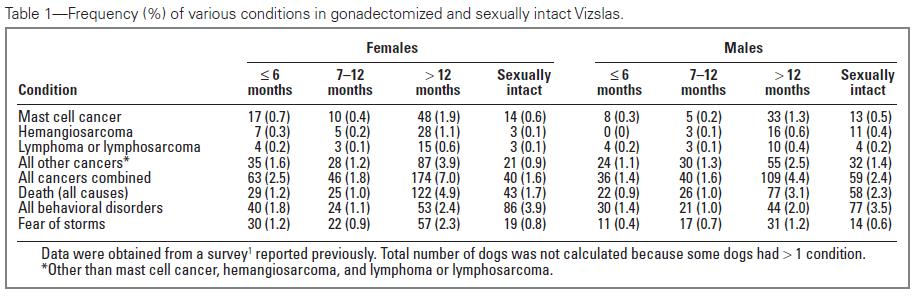
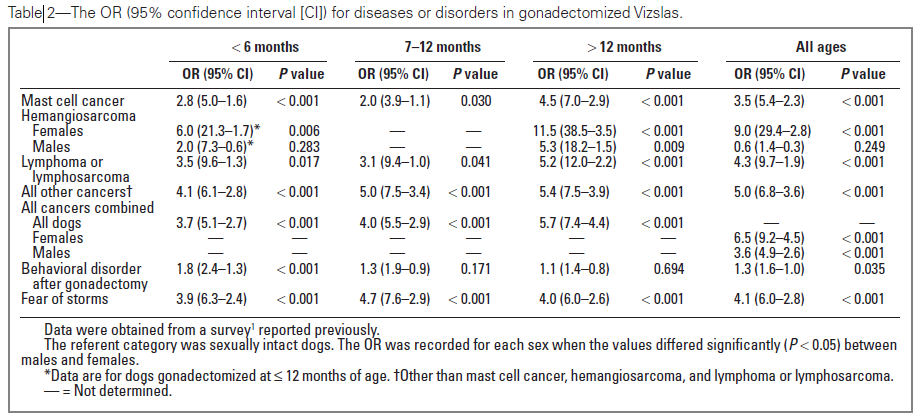
The reported results cover several cancers that are especially common in Vizslas, including Mast Cell Tumors (MCT), Hemangiosarcoma (HAS), and Lymphoma (LSA), as well as behavioral problems (noise phobias, separation anxiety, and various forms of aggression). The general results, broken down by age of neutering, are reported in the tables below.

Table 1 Zink et al

Table 2 Zink et al

The odds of MCT and LSA were higher for neutered than intact animals. The odds of HSA was higher for neutered females than for intact females, but there was no relationship between neutering and HSA risk for males. The odds of cancers other than these three were also higher for neutered than for intact animals. For all of these cancers, the odds were higher in those neutered after 12 months of age than in those neutered earlier.

For behavioral problems evaluated, the odds of having such a problem were higher in dogs neutered before 6 months of age than in intact dogs. There were no differences in the odds of behavior problems between intact dogs and those neutered after 6 months of age with the exception of storm phobia which was more common in neutered animals overall than in intact animals.

There was no difference in the age at death or the longevity of neutered dogs compared with intact dogs.

Limitations of the Study
The first potential limitation of this study is that the population of dogs included are potentially not representative of the general pet dog population. Only one breed was included, and only 60% were reportedly kept as “primarily a family pet,” with most of the others being used for show or hunting activities. About 23% were reported to have had offspring and almost half (43%) of the dogs were intact, whereas surveys suggest over 80% of the overall owned dog population is neutered. The average age at death was also reported to be 9 years, which seems quite young compared to many other breeds and mixed-breed dogs of similar size. Since there are genetic factors involved in many health conditions, and potentially developmental and environmental factors associated with how dogs are kept, caution must be used in extrapolating results from one population to another.

Another significant limitation of this study is the method of data collection. All data was collected by anonymous online questionnaire, with no attempt to verify the accuracy or validity of these data. Diagnoses of cancer and behavioral problems and assessment of age at neutering were based entirely on reports of owners, sometimes many years after the fact.

This raises a host of concerns. Owners may have reported diagnoses incorrectly, such as misidentifying cancers or reporting benign tumors as “cancer.” Owners may have been more likely to report cancer and/or neutering information if they believed there to be a relationship between the two or if they knew one purpose of the study was to examine such a relationship. Owners also identified cancer and skin conditions as top health concerns, suggesting a population of respondents particularly interested in these conditions, which might have affected their rate of reporting them.

There is also no way to identify what if any differences there were between people who participated in the survey and people who did not, or between the dogs owned by these different groups. It is likely that people who were aware of the survey and motivated to complete it differed in numerous ways from other Vizsla owners and owners of other kinds of dogs, and this again could affect the health conditions reported and the risk factors affecting them.

Another issue is that this study looked at potential risks posed by neutering, but it did not include assessment of most of the potential benefits of this procedure in this population. For females, for ecample, neutering is believed to be protective against mammary cancer (though the evidence is not as strong as commonly supposed), which in some populations is a very common and frequently malignant type of cancer. In this population, mammary cancer was reported in less than 1% of the females in the study, a rate dramatically less than in other populations studied. This suggests either that this population is a much lower risk of mammary cancer than others, in which case the protective effect of neutering might not be meaningful, or that the incidence of this disease was underreported.

Similarly, uterine infections (pyometra) are a common and serious disease in intact females, and these can be completely prevented by neutering. Yet the rate reported in this study was quite low. 22 cases were reported, which would be a rate of about 4% of the ~535 intact females included. Other studies have reported rates of 10-50% depending on age, so either this population has an unusually low rate of this disease, or the incidence was not accurately reported.

Health problems and cost or disruption for owners associated with estrus, reproductive behaviors, or actual reproduction were also not evaluated in this study.

Overall, the study found no difference in the longevity or overall mortality of neutered versus intact dogs. This is in contrast to other studies which suggest neutered animals may live longer on average than intact animals. More importantly, it calls into question the significance of the reported increase in cancer risk in neutered dogs. If neutered dogs are truly at significantly higher risk of often fatal diseases like HAS and LSA, one might expect intact animals to live longer as a results of being less likely to experience these diseases. And if the two groups have roughly the same life expectancy, perhaps there are benefits to neutering not reported here that counterbalance the risks discussed?

Bottom Line
This study contributes useful new information to the ongoing process of evaluating the risks and benefits of neutering. It supports information from other studies, in Rottweilers and Golden Retrievers, that suggest neutering may increase the risk of some cancers, such as hemangiosarcoma and lymphosarcoma, in breeds predisposed to develop these diseases.

The study also has a number of significant limitations. The dogs in the study were all of one breed, and they differed in a number of ways from the general pet dog population, so findings in this group may not be applicable to other populations.  The data was collected though anonymous questionnaires completed by owners, often years after the events being asked about, and there was no way to confirm the accuracy or validity of these reports. There is also a high risk that the people who chose to participate in the survey, and the dogs they own, are quite different from the general pet owning population and their pets, in their concerns, knowledge, and pet care practices.

The study did not examine many of the risks posed by being intact, which have to be considered in weighing the overall risks and benefits of neutering. Rates of pyometra and mammary cancer, common and serious medical problems prevented by neutering females, were far lower in this study than generally reported elsewhere, suggesting either that the study population was quite different from other dog populations or that the rates of these diseases were not accurately reported.

And it is unclear how significant the reported increase in the risk of cancers in neutered animals really is since there was no overall difference in the longevity of neutered and intact animals. If neutered animals are much more likely to get cancer, it is surprising that they tended on average to live just as long as intact dogs.

Overall, this study supports the current trend towards questioning the dogma of routine neutering for all dogs. The risks and benefits are likely to vary according to breed, age, and many other variables, and a one-size-fits-all approach is not ideal. Unfortunately, a great deal of additional research will need to be done for dog owners and veterinarians to have confidence in specific recommendations for individual dogs.

Posted in Science-Based Veterinary Medicine | 15 Comments

Academy of Veterinary Homeopathy Doesn’t Like Criticism–Except Their Own

During the discussion about the AVMA resolution identifying homeopathy as ineffective, defenders of homeopathy were adament that it would be unfair of the AVMA to single out their methods for criticism. I wonder if the House of Delegates was aware of the sort of criticism of conventional medicine, and the AVMA, that routinely appears on the Facebook page of the Academy of Veterinary Homeopathy (AVH), the official organization representing veterinarians offering homeopathy. The AVH is very comfortable blaming conventional veterinarians and treatments for all kinds of terrible health problems and denying fundamental scientific principles behind conventional medicine. Are these really the sorts of comments it is unfair to challenge?

“What things make your pet more vulnerable to cancer? Anything that impairs immune system function.  The following are, in order of importance, those things your animal receives that cause immune system breakdown:  Vaccination  Heartworm pills  Flea pesticides  Antibiotics”

“There is a big push underway to get pet owners to return to conventional veterinarians… and guess who is paying for it. Yup big pharma and the commercial food companies like Hills… what a surprise!!! Don’t be fooled. Holistic vets actually keep your pets healthy and happy at a fraction of the cost. To find one visit www.theavh.org

“Are germs really the problem???

Why homeopathy is your BEST option for treating your beloved animal friends…

Only homeopathy actually corrects the predisposition to illness or disease – making your pet (the soil) less vulnerable – and healing quickly and completely when their resistance drops due to stress or other factors.”

“As I look time and again at when my patients started their decline into poor health, I repeatedly see the timing being “about a month” after a round of vaccinations. Not in every case, but in a large percentage of my patient population, this is true.”

“Did you know that when it comes to feline leukemia, EVERY SINGLE vaccine is unnecessary. Why? FeLV is a chronic disease, and vaccines by definition don’t prevent chronic disease. And FeLV is very much an opportunist virus, attacking and setting up housekeeping in only 10% of those exposed. You can imagine these are the weaker, poorly nourished animals, likely eating an unnatural kibble diet.”

“Dr. WhiteCoat and the monstrously huge pet food industry (sales of $20+ billion per year) would like you to believe you can’t possibly make a raw diet for your pets. They are invested in selling you bags of kibble, cans of mucky meaty glop, and the best marketing of all, “prescription diets” for those health challenges your animals may confront.”

“We interrupt our normal posts for an important announcement.  The CDC is reporting sharp increases in the number of patients with swine flu. Homeopathic physicians have long used the homeopathic remedy Influenzinum to safely protect their patients from the flu with great success. The normal protocol – Influenzinum 200C – one pellet dissolved in the mouth once a month. In cases where flu is widespread – a dose every two weeks during a period of widespread flu is often advised. There are also an array of wonderful remedies one can take for flu symptoms – again that are safe, quick acting and effective.”

“Treatment with allopathic drugs (antibiotics, steroids, hormones, etc.) should be avoided unless absolutely necessary. The need for drug treatment is actually quite unusual, and should be considered a last resort.”

“Corticosteroids (cortisone-type anti-inflammatory drugs) are the most abused and dangerous class of drugs. Not only do they not cure the underlying cause of the problem, they usually make the underlying problem, that is, the real problem, worse.”

“Allopathic (conventional Western) medical thinking generally seeks immediate gratification: just make the symptom go away. So the patient may be better in the short term, but is usually worse in the longer term. Homeopathy is just the opposite: sometimes the symptoms are worse in the short term (such as with aggravation or the reversal of a previous suppression), but the real benefit is in the longer term.”

“Sadly, did you know that your dog has a 50% chance of dying of cancer? Want to know the five steps that can significantly reduce your pet’s chances of getting cancer? Here they are:

* Reduce or eliminate the use of commercial flea and tick products. They are poison.

* Stay away from using pesticides, herbicides and fungicides on your lawn and garden.

* Use non-toxic cleaning products for your home.

* If you must alter your dog or cat – don’t do it too early in their lives.

* Eliminate or greatly minimize their exposure to vaccinations.”

And the AVH actually promoted one of the most misleading and dishonest news stories of the last year concerning veterinary medicine: ”

“Is your vet being honest with you???  Well, on a recent episode of ABC’s 20/20, common veterinarian practices were examined in a piece entitled ‘Is Your Veterinarian Being Honest With You?

Worth watching.”

Posted in Homeopathy | 2 Comments

On CAVM Research and Plausibility

I have been participating in a discussion on the Veterinary Information Network (VIN) about the AVMA’s failure to take a scientific and principled position on homeopathy, and it prompted me to outline a few thoughts on the subject of whether more research on some CAVM therapies is always worthwhile, and what the role of plausibility plays in evaluating such therapies. I’m reposting these thoughts here since these subjects come up often on this blog.

I once thought the answer to separating useful CAVM from nonsense lay in more research. Having spent several years investigating CAVM and the claims and rationales made for it, I realize this is not actually that likely to be helpful, for many reasons. One is that much of CAVM is based on philosophical and ideological foundations completely incompatible with science, and the promotes of these “metaphors” don’t have any interest in applying science to their practices other than its potential value as a marketing tool for creating broader acceptance and legitimacy. (I have written about this before.)
For scientific research to be useful in separating true from false, we must be willing to accept negative results and abandon therapies even if they seem effective in our uncontrolled personal observations. There is rarely any serious will to do so among proponents of CAVM, as illustrated by the homeopathy debate and the comments you and Craig have made about the views of some acupuncture proponents.

It is also the case that the vast majority of the CAVM research done, in human as well as veterinary medicine, is of poor methodological quality and very high risk of bias. It is possible to find many positive studies on almost any practice, yet systematic reviews that base conclusions on well conducted studies with limited bias risk almost always conclude there is no effect beyond placebo. All these poor studies suck up scarce resources and create a misleading impression of the state of the evidence. Again, to help us distinguish true from false, scientific methods have  to be employed in ways that generate reliable evidence that leads to meaningful conclusion which can be applied in practice, and this is seldom the case in CAM research.

So if the research done will not dissuade true believers and is generally unreliable and misleading, how is it going to clarify our understanding or inform our practices? I’m not saying no CAVM should be researched, of course, only that in many cases (such as homeopathy, energy medicine and other forms of vitalism, etc.) the answer is already as clear as it can reasonably ever be, or the fundamental premises of the methods are not amenable to science and rigorous scientific research is not welcomed or heeded by proponents. In these cases, the resources used to conduct such research are wasted and the waters only further muddied.

Which brings me to the second response evoked by your comments. Of course, plausibility is not the definitive standard for judging the efficacy of a therapy. However, the fact that plausible ideas are sometimes false and implausible ones sometimes true doesn’t mean we should jettison plausibility entirely as a tool in evaluating therapies. The pioneering epidemiologist Sir Austin Bradford Hill discussed the multiple interacting criteria for establishing a causal relationship and both the weaknesses and the utility of plausibility in a classic paper I think every clinician should read many times, and which I have also written about before.

Plausibility is a bit like our clinical index of suspicion–it doesn’t give us a definitive diagnosis, but it helps us start moving in the direction most likely to be productive. In the case of veterinary medicine, where resources for research are so scarce, do we really want to spend them on studies of ideas which can only be true if multiple well-established principles of basic science are false? Should we indefinately call for more research on homeopathy and methods for balancing Yin and Yang, or should we put most of our energies and talent towards ideas with a bit higher probability of being true? Plausibility is one of many factors to consider in weighing botht he mertis of a therapy and the value of further research.

Finally, of course all the same principles we are talking about apply equally to conventional therapies. Much of what we do in conventional medicine lacks high-quality supporting evidence, and some of it is even implausible. I challenge the pharmaceutical reps I talk to as vigorously as the herbalists, and I haven’t made any more friends in the world of stem cell therapies or hyperbaric medicine than I have among TCVM practitioners.

However, it is fallacious to suggest, as is sometimes done, that the criticism some of us are making of unconventional medicine are somehow weakened or inappropriate just because conventional medicine is imperfect. Trimming the dross from our repertoire and strengthening the quality of science and care we provide should reasonably start with the least defensible practices. And while I may respect the intelligence and genuine commitment to patient welfare of colleagues who support such therapies, their good perosnal qualities are not really evidence for the therapies they promote any more than the often venal and malicious behavior of some in the pharmaceutical industry is evidence that their products don’t work. As you say, our interventions need to stand on the merits of the evidence concerning them, and opinion is not evidence regardless of the strengths or weaknesses of the source.


Posted in General | 2 Comments

Pet Owners Beware: Why Owners Should ask Veterinarians about the Evidence behind their Treatments

I was recently interviewed for an article on the nature of evidence in veterinary medicine, and why pet owners should be concerned about the evidence their veterinarian uses to support his or her recommendations. If clients demand the therapies given to their pets be based on good science, veterinarians will make this happen. If pet owners simply accept personal experience of anecdote as the reason for using a particular treatment, they won’t be providing their animal companions with the best possible care.


kaleb

Pet Lovers Beware: Too Often, The Drugs  Don’t Work

So ask your vet why they think the drugs your animal is being given will work. We’re going to have to confront our own psychological biases, here: research shows that people prefer confident advice, sometimes even when we know those giving it have been wrong before. And good answers to these questions will inevitably be hedged with caveats about the small number of studies that have been done, and their limitations. If all you get from your vet is a bland assurance that they’ve been doing this for years, and see great results, get them to talk you through the scientific evidence. If they can’t do so, that should be a warning sign: It might be time to look for another vet.

Our companion animals do great things for us, improving not just our psychological well-being but also our physical health through knock-on effects like reduced blood pressure. The least we can do in return is to challenge vets to base their decisions on the best available science.

Posted in Science-Based Veterinary Medicine | 1 Comment

Leader of Holistic Veterinary Foundation Expresses Troubling Ideas About Science

The American Holistic Veterinary Medical Association (AHVMA), and the associated foundation (AHVMF) appear frequently in articles on this blog. These organizations represent a large portion of alternative veterinary practitioners, and the AHVMF is involved in significant efforts to spread the gospel of alternative medicine through funding scholarships, faculty positions, and purported research centers focused on alternative therapies. I have writen before about the concern that the efforts funded by the AHVMF are likely to be more marketing than science, focused on promoting therapies rather than on an honest, science-based assessment of their real risks and benefits.

A number of comments made by Dr. Richard Palmquist, the leader of the American Holistic Veterinary Medical Foundation’s very successful fundraising efforts ($900,000 in two years by their report), support this concern. The view of “science” (almost always in “scare quotes” like these) expressed in these comments does not suggest the AHVMF leadership is open-minded about the posisbility that any alternative therapies might be shown to be ineffective (which is unsurprising since, after all, the group vigorously promotes homeopathy). It seems much more likely that this is a group with an unshakeable faith in their beliefs who are simply looking for ways to spread these beliefs using a veneer of scientific legitimacy.

As I’ve said before, I don’t doubt the sicnerity of these folks’ belief in their practcies, nor the superficial honesty of their claims that they want scientific support for these. What I doubt is their ability to set up and generate truly high-quality research and accept evidence inconsistent with their beliefs. It is vital that science not become a mere marketing tool, with lip service paid to research while poor quality marketing studies are produced heavily biased to find the results their funders wish to find. This has been a persistant problem in the pharmaceutical industry, with harmful results for patients, and the same strategy is likley to predominent in the area of alternative therapies, with the same results, if high scientific standards are not adhered to.

“Scientific advance can be fueled by a few people who have experienced the impossible and who care enough to investigate and share.”

“When we use “science” to kill hope by stopping progress we find real harm occurring.”

“Love and Truth are brick and mortar in the path from impossible and implausible to possible.”

“Funny that science advances from “impossible” to “it happens,” to “here’s how we do it.””

“Comfortable science involves reading & discussing well established data. Uncomfortable science occurs in the interface inhabited by pioneers”

“”Study” means “to look.” Deniers of Truth often refuse to look as a strategy to protect their ignorance or false authority.”

“If someone criticizes you for seeking love and truth, smile and continue because success is approaching sooner than you might think. :-)”

“Truth once raised is often greeted by antagonism, debate and attack, but being Truth it can and does persist. Dialogue & love gives breath.”

“A miraculous response on one patient can not prove cause, but similar results open the door to research and understanding. We want to know! Creating dialogue between clinicians and academic researchers allows for information to move more quickly. Report ur miracles.”

” thanks for believing in miracles.”

“When a miracle surpasses our science, we can deny the miracle or use our science to pursue improved understanding. It’s a choice.”

“The road to miracle can be short or painfully arduous as we expand our possibilities always seeking truth and a better way. Keep walking…”

“Miracles provide us the opportunity to see and share the unexpected as we gain insight into new relationships. RT if u believe in miracles.”

“Placebo effect (that means YOU) are responsible for HALF of a drug’s effect. How about making more of YOU!?”

“90.1 percent of AVMA delegates voted against the anti homeopathy resolution. Veterinarians free to pursue whatever tools needed to help.”

“In the end we do not heal from finding out what is wrong. We heal when we find and connect what is right with our lives.”

“We will have health reform when doctors become team members celebrating and developing potential and not simply pill prescribers.”

“Thousands of scientific paper exist for homeopathic agents. Science is developing much more rapidly now. If we look we discover truth.”

“People who are sure they know how the universe works are often in for a surprise. “Scientists” often fight what turns out to be right.”

I suppose I must be a Denier of Truth using science to kill hope? Hmmm….


Posted in General | 12 Comments

Veterinary Clinical Decision-Making and Cognitive Bias

As part of the rationale for the application of EBVM, it seems necessary to illustrate the deficiencies in other approaches to evaluating therapies and making clinical decisions. As infectious disease specialist Mark Crislip puts it.
Often getting the right diagnosis and therapy is less about what you know and more about being rigorous about understanding how you know. Only when you are conscious of your ability to think poorly, can you compensate.
In this spirit, I contributed a commentary to the Journal of the American Veterinary Medical Association about the processes and pitfalls of clinical decision-making, with an emphasis on the effects of cognitive biases and the need for formal methods to compensate for these.
McKenzie, B. Veterinary clinical decision-making: cognitive biases, external constraints, and strategies for improvement. Journal of the American Veterinary Medical Association. 2014;244(3):271-276.
Posted in Science-Based Veterinary Medicine | 1 Comment

An Oral History of Evidence-Based Medicine

The Journal of the American Medical Association and British Medical Journal have produced a video of a discussion with some of the founding figures of the Evidence-Based Medicine movement. This offers some great insights into the improtant and fundamental shift in how clinical practices are evaluated in human medicine, and why such a shift needs to happen in veterinary medicine as well. I encourage everyone to have a look!


EBM oral Hx


Posted in General | 1 Comment